
White Commodore Butterfly Caterpillar with Parasitic Wasp Cocoons

Parasarpa dudu
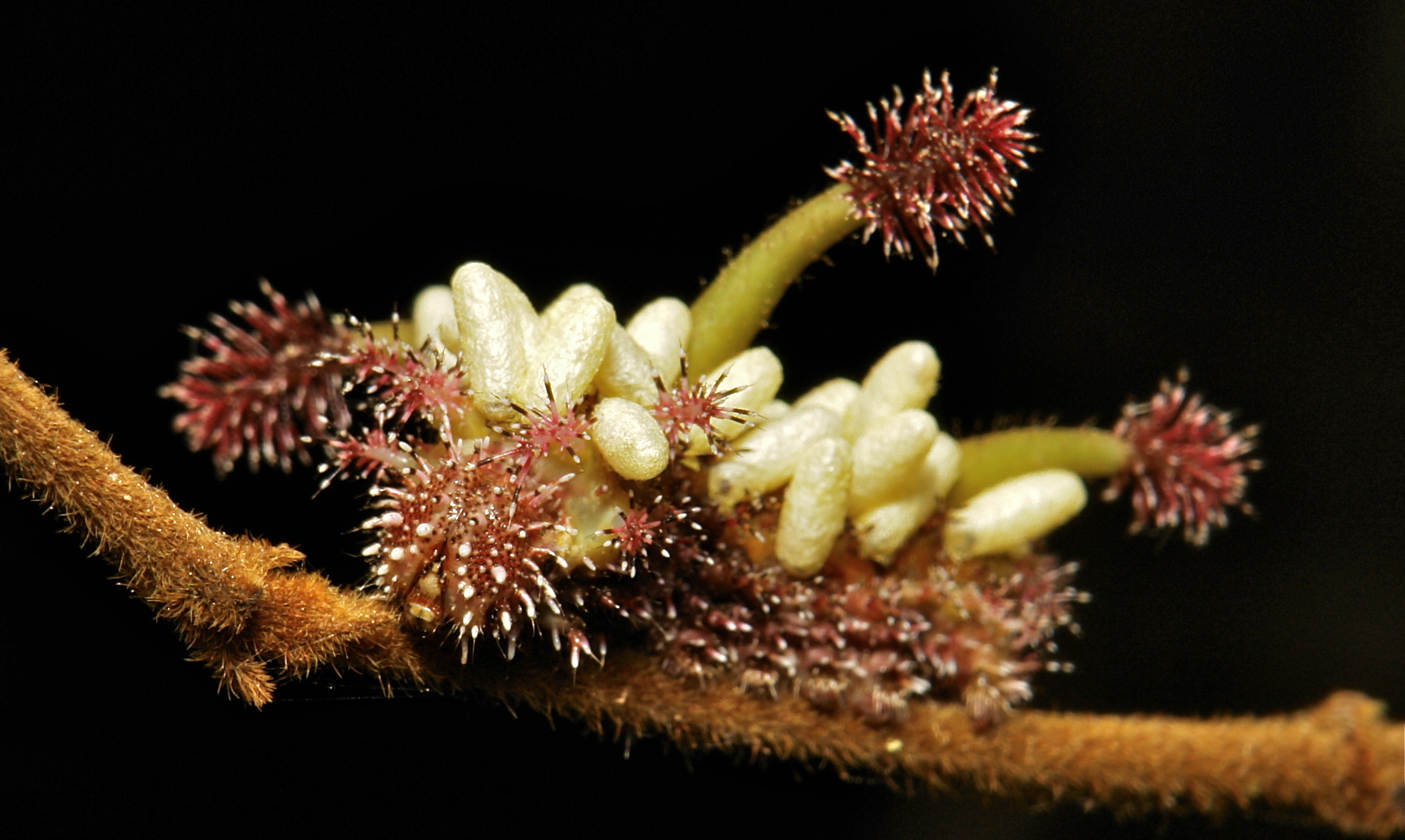
Photo by Sinobug
Published on Project Noah
Zoom
NominateNominate for Wildlife Photograph of the Month
reportFlag Spotting

22.7733, 100.971

Field Notes

Description:

I would have much preferred to find this astonishing tentacled pompom-wielding caterpillar without its heavy burden of parasitoid wasp cocoons, but nature is a twisted malicious wonder. Most likely without it's terminal affliction, this caterpillar would not have been so easily spottable so we could bear witness to its splendour and its grisly demise.

Firstly, this is the larva of the White Commodore (Parasarpa dudu, Nymphalidae). See the butterfly here.....
http://www.flickr.com/photos/itchydogimages/8463976414/

This individual is bearing braconid wasp (Braconidae) cocoons on its back which means the parasitic phase of the relationship is over but the caterpillar's future is limited.
The course of events is as follows: braconid wasp eggs are laid on the host's skin. Larvae burrow inside the caterpillar, which at first continues to develop almost normally as the wasp larvae selectively devour non-essential tissue (after all it is essential that the host survives long enough for the wasp life cycle to be completed). They eventually stop feeding and cut holes in the host's skin in order to reach the outside. They pupate inside white cocoons spun on the host's skin. The caterpillar often dies before adult wasps emerge from cocoons.

Species ID Suggestions

Comments (32)

This unfortunately caterpillar finally has a name. It is the larva of the White Commodore (Parasarpa dudu, Nymphalidae).
Thank you all for your comments. And that Darwin quote courtesy of John La Salle is very appropriate and profound. As an update, I revisited the site this spotting yesterday, 5 days since taking the picture, and the poor caterpillar was in the same place, still alive and still burdened. It has been demonstrated that the presence of the wasp larvae somehow manipulate the "brains" of their various victim hosts into 'playing safe' once again to prevent the caterpillar coming to grief before the wasp life cycle has been completed and all would be lost.
Great spotting and congratulations on SOTD!!!
Wonderful spotting - congratulations on your SOTD!
Awesome spotting, congratulations Sinobug!
Congratulations for SOTD! You have a lot of great spots. Enjoying going thru them.
Awesome spotting! Congratulations on another fantastic spotting of the day!
Congratulations !
This is crazy, congrats on Spotting of the Day!
Congrats Sinobug, this awesome photo has earned you another spotting of the day: The amazing caterpillar will sadly never metamorphose into a butterfly or moth. Wasp larvae have completed their life cycle inside its body, miraculously keeping it alive before exiting their host to pupate externally. https://www.facebook.com/photo.php?fbid=10152591888590603&set=a.10152383557885603.943728.10150120463815603&type=1 https://twitter.com/projectnoah/status/306607762769575936
Incredible capture Sinobug!
In the workings of natural selection and evolution that we observe around us there is little indication of benevolence or perfection. Its survival without compassion really. I think most of us would have designed nature to be vegetarian at least. Still it is breathtakingly complex and stunningly awesome.
“I cannot persuade myself that a beneficent and omnipotent God would have designedly created parasitic wasps with the express intention of their feeding within the living bodies of caterpillars.” - Charles Darwin
Great photo of this fascinating but morbid phenomenon. You can almost feel the texture of the cocoon..
I would actually really love to get an ID, or near ID, on the caterpillar. It is an astonishing creation. Another image here..... http://www.flickr.com/photos/itchydogimages/8509210416/
This wasp lifecycle is typical of the Braconids locally, although an Ichneumonid parasitoid wasp could not be excluded. And these are not eggs. They are the end stage pupa/cocoons. The wasp larva have already completed their life cycle inside the caterpillar, miraculously keeping it alive before exiting their host to pupate externally. Here are some other examples..... http://www.flickr.com/photos/itchydogimages/8276729010/ http://www.flickr.com/photos/itchydogimages/8126492467/
What an amazing scene. I'm curious why you choose Braconid eggs? Could it possibly be an Ichneumon or other or is this something only Braconids do??

Accelerate our Mission to Photograph 
Every Species in the World!

Image
Butterflies icon

Wildlife Community

Wildlife Community

Join a worldwide community passionate about wildlife and nature!

Join Project Noah

Nature School

Nature School

Transform your green space into a curiosity-creating nature classroom!

Visit Nature School

Wildlife Game

Wildlife Game

Defend wildlife throughout the jungle in thrilling nature game!

Play Baboon