


Requiem for Noble Shell
There was a time, not so long ago, when encountering a noble pen shell in the Adriatic felt like stumbling upon a minor marvel — a creature spoken of with a mix of familiarity and disbelief. Upright in the seagrass, half-buried yet impossibly tall, it looked less like a mollusc than a misplaced relic: a shard of something ancient, quietly asserting its presence in shallow bays and coves. For amateur divers and snorkellers, it was a prize of sorts — not to be touched, only noticed — remarkable above all for its size, for the way it stood there as if it had decided, long before any of us arrived, that this particular patch of seabed belonged to it. Older fishermen remembered when such shells were more common, when their flesh had occasionally found its way to the table and their silky fibres — teased from the depths like a secret — were spoken of with a certain reverence. By the late twentieth century, the species was already protected, shielded by law long before most people learned its name (under Yugoslav conservation legislation introduced in the 1970s), yet it retained that aura of quiet exception: legal, legendary, unmistakable. To see one was to pause, to point, to surface later and tell someone you had seen something rare — not because it was forbidden, but because it was still there.
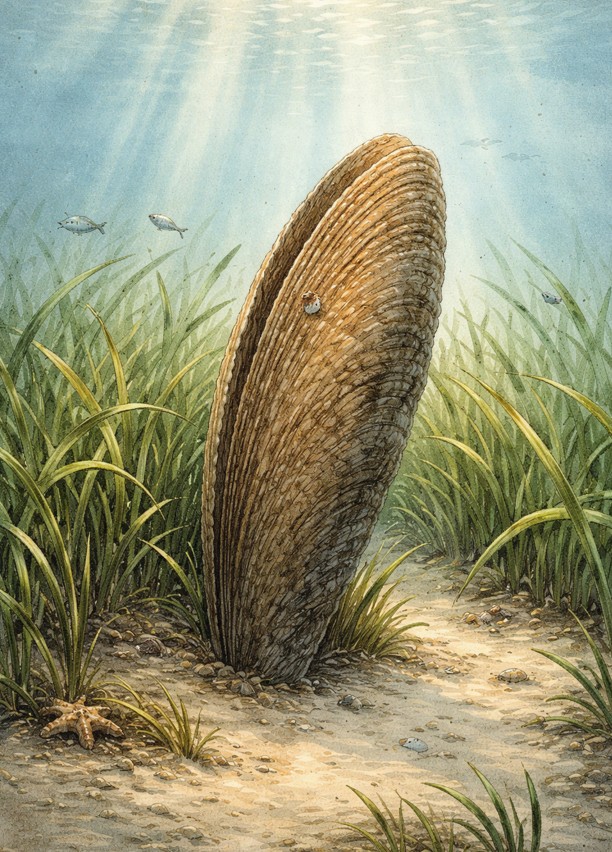
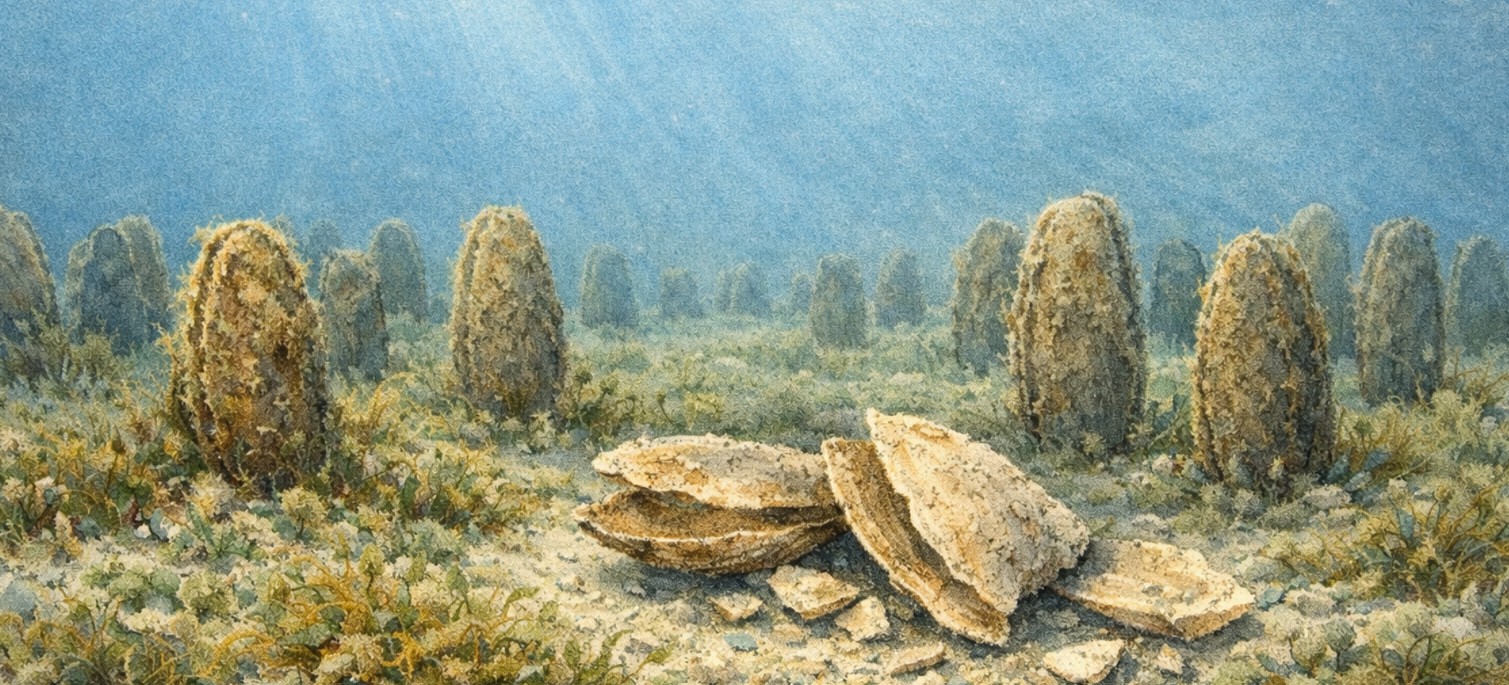
And then, almost without ceremony, they began to disappear. Not through overharvesting or scandal, not even through a slow, visible decline, but in a manner so abrupt it took time to recognise it as loss at all. One summer the shells were still there, standing patient in the seagrass; the next, they were empty, their interiors scoured clean, their presence reduced to a brittle outline. Divers noticed first — the absence where something had always been — and only later did the word spread that this was not local, not accidental, not temporary. What had seemed protected and enduring proved suddenly fragile. The noble pen shell did not retreat; it died in place, leaving behind rows of upright shells that resembled markers more than remains. By the time the cause was named, the damage had already moved on, travelling currents faster than observation, erasing a species that had survived centuries of human attention in a matter of years.
What followed was not a mystery for long, but it was never simple. The noble pen shell had not merely declined; it had been overtaken. A microscopic parasite — Haplosporidium pinnae — entered the Mediterranean quietly and found in Pinna nobilis a host almost entirely unprepared. The infection moved inward, attacking the digestive tissues first, undoing the animal from within, often killing it in days. In many cases, bacteria followed, opportunistic and efficient, turning illness into certainty. Warm summers hastened the process; calm waters carried it further. The shells remained upright, anchored by habit even in death, giving the illusion of survival long after the animal inside was gone. By the time scientists understood what they were seeing, entire meadows had already fallen silent. Protection, it turned out, had guarded the shell from human hands, but not from a living thing small enough to pass unnoticed through a warming sea.
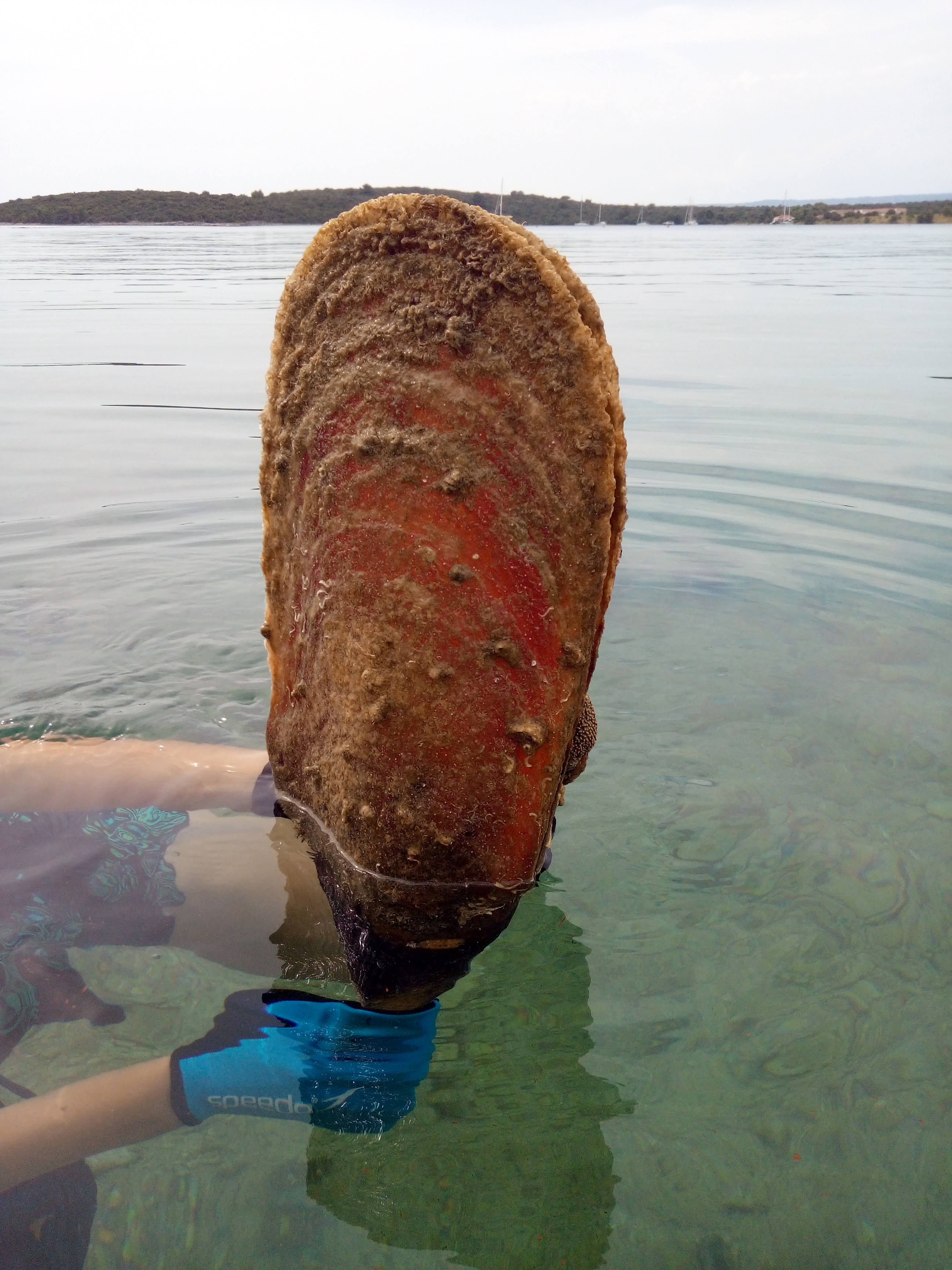
I came to understand all this only later. At the time, it was simply a shell — lifted carefully from the shallows by my son on Pelješac, heavy in the hands, intact, strangely beautiful. It did not feel like a discovery so much as a keepsake, the sort of object children bring back without knowing why it matters. Only afterwards did unease set in: the sense that this was not an old remnant, not a relic worn smooth by years of tide and neglect, but something recently vacated.
Curiosity followed, then questions, and then the slow unravelling of a story far larger than that single moment by the water. I began to read, to ask, to recognise familiar places — bays, islands, stretches of coast — threaded through reports of disappearance. What had seemed like an isolated encounter revealed itself as part of a wider pattern, unfolding quietly across the Adriatic and beyond, largely unseen unless one had reason to look more closely.
Unlike the Great Barrier Reef, whose collapse the world learned to recognise, some great ecological tragedies leave no headlines behind, noticed only by those who are there, and who pay attention.
Once I began to look beyond that single shell from Pelješac, the scale revealed itself with unsettling clarity. What had happened was not local, nor accidental, nor brief. From Spain to Italy, from the French coast to Greece, from shallow lagoons to deeper seagrass meadows, the noble pen shell had fallen in rapid succession. Entire populations vanished within seasons. Reports spoke of losses measured not in percentages but in near-total absence — a Mediterranean emptied of its largest bivalve in the span of a few years. In the Adriatic, where the species had long felt almost emblematic, the silence came swiftly: sites once dotted with upright shells reduced to memory, protected areas no more resilient than open bays. There were no dramatic images, no bleaching whites visible from the air, no single moment that could be pointed to and named. Instead, there were divers returning puzzled, empty shells standing like placeholders, and the slow realisation that something foundational had slipped away while most of us were looking elsewhere.
What remains now are fragments: a handful of resistant individuals kept under watch, shells catalogued in reports, memories traded between those who noticed the absence early enough to be unsettled by it. The noble pen shell has not yet become a symbol in the public imagination, perhaps because it did not fail loudly, or beautifully, or all at once. It simply stopped being there. And for those who once knew where to look — who remember the pause it demanded, upright and improbable in the grass — that absence carries its own weight, heavier than the shell ever was.
Its disappearance is inseparable from the fate of the seagrass meadows themselves, for each upright shell once filtered the water, anchored life, and lent quiet stability to an ecosystem that now feels thinner, more exposed, and less certain of its own endurance.
I still see my son lifting that shell from the shallows on Pelješac, struggling slightly with its weight, pleased by its size. It was already empty, packed with sand and small debris, its inhabitant long gone — a fact that was obvious even then, and quietly reassuring. To him, it was simply a marvel: something solid and beautiful brought briefly into the light, then returned to the water. Only later did it become clear that the weight he felt was not just that of calcium and sand, but of absence — a shell standing in for a life already lost. We put it back, of course, but the moment stayed with me. It marked the point at which noticing turned into attention, and attention into the slow understanding that some losses announce themselves only after the fact, when all that remains is the outline of what once stood upright in the grass.
What follows is not an attempt to enlarge this story, but to place it alongside others — a brief record of comparable biological collapses, noted here not for drama, but for context.
- Tasmanian devil (Sarcophilus harrisii) — Devil Facial Tumour Disease first detected 1996; population declines of 60–90% in affected regions by the 2010s.
- Sea stars (Asteroidea, multiple species) — Sea star wasting disease outbreak beginning 2013; >90% mortality in some species and locations along the Pacific coast of North America.
- Reef-building corals (Scleractinia, multiple species) — Stony coral tissue loss disease first observed 2014 (Florida), spreading through the Caribbean; 30–50% loss of coral cover in heavily affected reefs, with near-total mortality of susceptible species locally.
- Long-spined sea urchin (Diadema antillarum) — Caribbean-wide die-off 1983–1984 causing ~95–99% mortality; secondary regional outbreak reported from 2022 with severe local losses.
- Abalones (Haliotis spp.) — Withering syndrome recognised late 1980s–1990s; >90% declines in some wild populations along the Californian coast.
- Pacific oyster (Crassostrea gigas) — mass mortalities linked to Ostreid herpesvirus (OsHV-1) emerging 2008 onwards in Europe; 30–80% losses in juvenile cohorts during outbreak years.
- Amphibians (class Amphibia, multiple species) — Chytridiomycosis spreading globally since 1970s–1980s; declines in >500 species, with 90+ extinctions or presumed extinctions attributed to the disease.
- Bats (order Chiroptera, multiple species) — White-nose syndrome first recorded 2006 in North America; >90% mortality in some hibernating species, with millions of individuals lost.
Note on illustrations: The drawings included in this piece were created using artificial intelligence, based on photographic references and ecological descriptions, to support visualisation where direct images were not available.



Comments (0)